Damp surveys and reports in Teesside
A damp survey establishes why a wall is wet before anybody quotes to treat it. Expect £150 to £350 on Teesside for an inspection with a written report, drilled sample testing where needed, photographs, and a specification of works you can send to more than one contractor.
Why pay for a survey at all
Because the cost of getting the diagnosis wrong is far higher than the survey. An injected damp proof course in a house whose real problem is a bridged course under a new drive costs £1,200 and fixes nothing. Replastering a wall that is still being soaked by a split downpipe fails within a year. Roughly speaking, anywhere the proposed works exceed about £500, or where two contractors disagree, a survey pays for itself immediately.
There is also the question of who is looking. A "free damp survey" offered by a company that sells damp proofing is a sales visit, and a perfectly honest one in many cases, but the incentive points one way. An independent surveyor with no treatment to sell has no reason to find rising damp where there is none, and no reason to miss it where there is.
What a survey involves
| Type | Scope | Guide price |
|---|---|---|
| Single-issue damp inspection | One room or elevation, cause, photos, short report | £150 to £250 |
| Full property damp and timber survey | Whole house, external and internal, timber decay check | £250 to £400 |
| Pre-purchase damp report | Written for a buyer, used in price negotiation | £250 to £450 |
| Laboratory salt and moisture analysis | Drilled samples tested for moisture and hygroscopic salts | £60 to £150 additional |
| Basement waterproofing design report | BS 8102 grade of use, system design, drainage strategy | £350 to £700 |
A competent inspection starts outside. Ground levels against the damp proof course, gutters and downpipes tested with water where possible, pointing and render condition, sills, airbricks, gully positions, and the exposure of each elevation. Inside it covers moisture patterns, plaster condition, salt bands, floor construction, ventilation provision, heating patterns, humidity and surface temperatures, plus a check of timbers in contact with damp masonry.
The instruments, and their limits
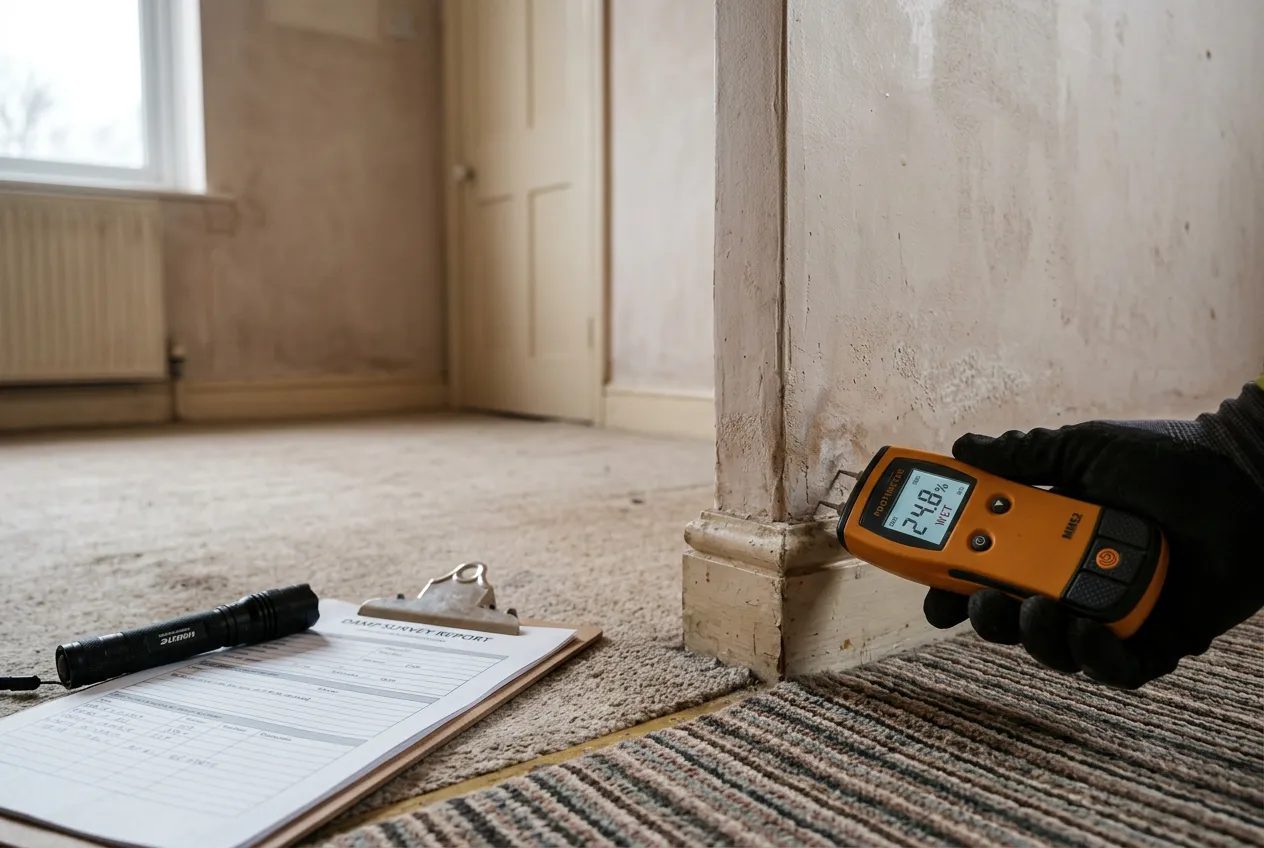
An electrical resistance meter measures conductivity, not water, so a wall carrying nitrate and chloride salts from a historic problem reads high when it is bone dry. That single fact explains a lot of over-diagnosis. A useful survey therefore backs the meter up with drilled samples measured on a carbide meter or oven-dried in a laboratory to separate moisture content from salt content, plus thermal imaging or a surface thermometer with a hygrometer to identify condensation risk properly.
What you should receive
- A clear statement of cause, with the evidence behind it, for each affected area.
- Photographs, and a plan or elevation sketch marking the extents.
- Measured quantities: linear metres of damp proof course, square metres of replastering, number of fans, so quotes are comparable.
- A specification referencing the relevant standard, BS 6576 for chemical damp proof courses or BS 8102 for below-ground work.
- Priorities and sequence, including anything urgent such as active leaks or timber decay.
- Where the surveyor cannot be certain, an honest statement of that and what further opening up would settle it.
Buying a house on Teesside
Homebuyer reports frequently include the phrase "elevated moisture readings, further investigation by a damp specialist recommended", which is a surveyor protecting themselves and tells a buyer almost nothing. A dedicated damp report turns that into a number, and that number is negotiable. On the terraced stock around Middlesbrough and Stockton, where a full ground floor damp proof course and replastering can run to several thousand pounds, it is one of the better-value pieces of paper in the whole purchase.
Once the cause is established, the treatment routes are covered on the rising damp, penetrating damp and condensation pages, with below-ground work on the basement waterproofing page.